This page summarizes . (Links to previously posted Picket Line pages expand on some things I mention. You can follow these links by clicking on the “♦” symbols.)
Picket Line Annual Report
, the U.S. attacked Iraq. This began a foolish, brutal, aggressive war, launched on dishonest pretenses, with disastrous results. For me it was the last straw, and I started what I then called “an experiment” in tax resistance so that I might no longer feel as complicit.♦ My goal was to stop financially supporting the U.S. government. That government has continued to get worse, and so my attitude continues to be one of not wanting its misbehavior on my conscience.
Tax Resistance
At first I had hoped to stop financially supporting the government entirely legally, by lowering my income below the federal income tax line. I quit my job to start a one-man consulting business in which I could regulate my income, and I took advantage of legal tax deductions and credits, while also attending to frugality. This turned out to be a successful way to legally avoid federal income tax, as well as a rewarding way to make a living, and I continue to operate this way today.
However, I have been liable for self-employment tax in most years (this is different from the income tax but also goes to the federal government). In I decided to stop paying that tax as well. I have not found a useful way to do this legally, so I simply neglect to send a check along with my tax return. As a result I have accumulated an unpaid tax bill which, along with penalties & interest added by the IRS (minus a bit that they’ve managed to seize from me over the years, and some that is now uncollectible due to the statute of limitations), now adds up to something in the neighborhood of $94,000.
My two-track strategy of legally avoiding income tax while extra-legally refraining from paying self-employment tax is somewhat awkward to explain, but works for me.
Many years ago, the IRS levied my bank accounts and seized about $6,200 of the total of about $154,000 that I have so far refused to pay. I don’t have any fail-safe plan to hide assets, so the IRS could continue to seize money when they find it. However they haven’t taken anything from me for almost twenty years, and they don’t even seem to have tried very hard, though they still send me pleading letters from time to time. This lack of enforcement may mean they’ve run out of easy seizure targets, or it may mean my overdue amount falls under the threshold at which they start trying harder. (Years of budget cuts and other crises made the agency something of a paper tiger, and then the already weakened agency fell victim to the haphazard decisions of DOGE and the trumperists.)
In , the IRS filed a formal tax lien against me in my local court system. They updated that lien in each of the following two years, stopped for a while, and have since occasionally reestablished the lien. The lien has not had any practical effect on my life or my tax resistance. The only effect I have noticed so far is junkmail from shady companies promising they can settle my tax debt for pennies on the dollar (the lien is a public document, so these companies use lien filings to target their sales pitches).♦ The lien didn’t even register on my credit report, which I found surprising.
The total amount I owe is well over the threshold at which the IRS is supposed to notify the State Department that I ought to be forbidden a passport and perhaps ought to have my passport revoked. It took the agency longer than I expected, but they eventually submitted such a notification .♦ This means that the State Department could revoke my passport at any time, and in any case is not supposed to allow me to renew it when it expires in . So far they have not revoked my passport.
, when another year of my tax debt became uncollectible due to the statute of limitations, I wrote a check for that amount to the International Refugee Assistance Project, as a charitable donation to celebrate. I hope to make a similar donation to some charity in a couple of months when another year’s taxes seem likely to become uncollectible in the same way.
My 2025 Federal Tax Resistance
After all the dust settled, I “owed” and refused to pay $4,501 in federal taxes.
(I have not filed my taxes yet, so this may change once I actually sit down with the forms. I file paper returns for reasons. This has turned out also to be a way to measure the health of the Internal Revenue Service. When I began filing returns many years ago, it was typical for the government to have its tax forms ready for taxpayers to use no later than the beginning of February or so, by which time people were also receiving their W-2s and 1099s. If you were a keep-your-inbox-empty sort, you could file your taxes on February 1st, check it off the list, and smile condescendingly at people who were still scrambling in April. But over the past several years, the government has become less and less capable of having its forms ready by tax filing season. I’m still awaiting the delivery of several forms that apparently are not printed up yet, or are still stuck in their mailing queue. While I’m pretty confident attributing this to agency ineptitude, it’s also possibly a passive-aggressive way of discouraging people from filing paper returns.)
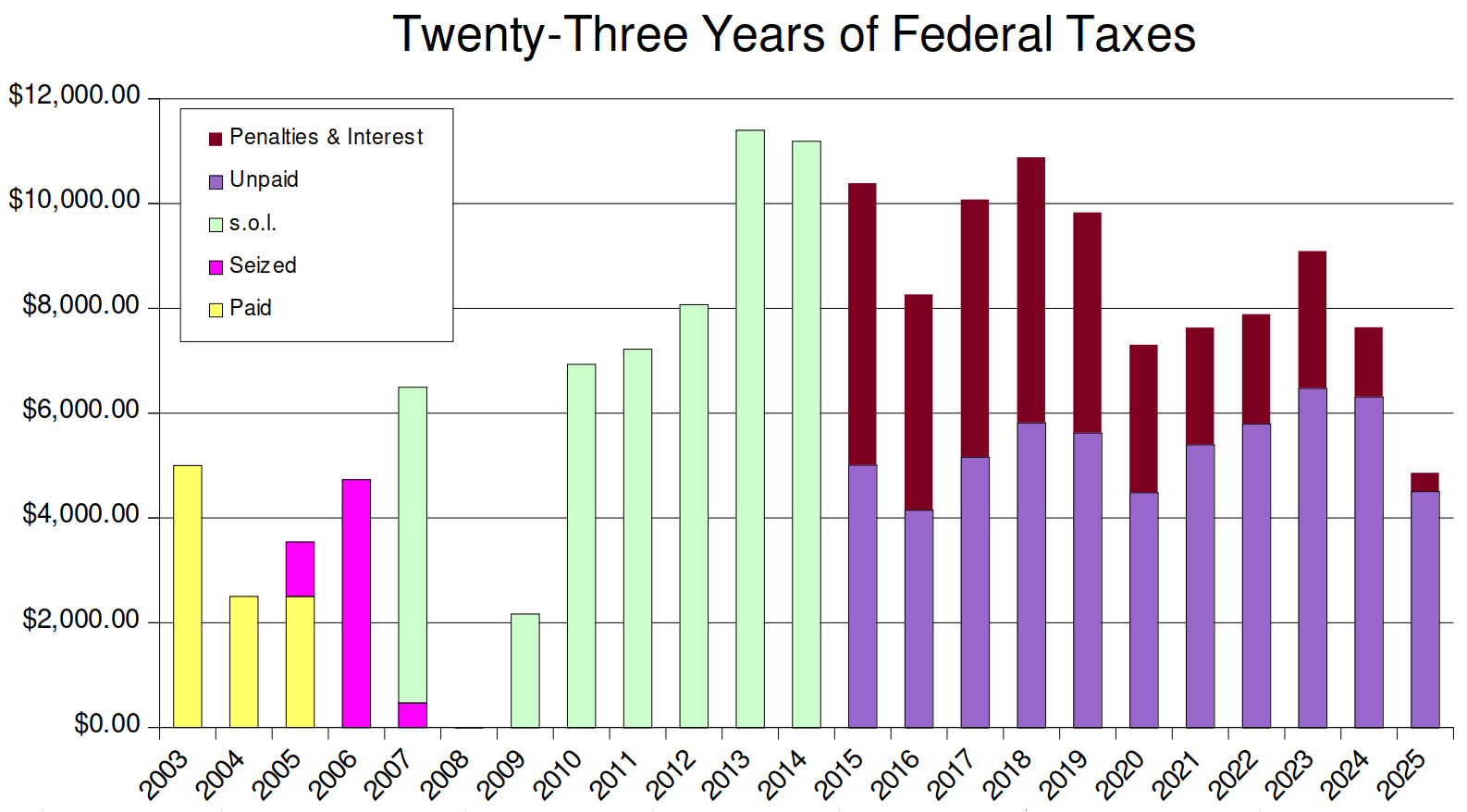
This chart shows my last twenty-three years of federal taxes. In my first three years of tax resistance, I avoided owing income tax but continued to pay my self-employment tax voluntarily. Then I stopped paying that tax, but the IRS seized enough money from me to pay for what I resisted in 2005 and 2006 and a small part of 2007. The rest of the 2007 amount, as well as the 2009–13 amounts, hit the statute of limitations deadline and these are now permanently uncollectible (s.o.l.). (In 2008 I did not bring in enough income to owe any federal tax.) Since then, the agency has collected nothing, though they continue to add penalties and interest to what they say I owe.
Sustainability
I want to continue to resist taxes for the long term, so it is important (if I want to stick to my below-the-tax-line method) that my expenses remain low enough that my income-tax-free income is sustainable. In I brought in almost $32,000 in profit from my business. My day-to-day expenses rose, thanks to inflation and such. Rents in my part of California are high, and rent amounts to nearly 60% of my annual taxable expenses. As best as I can estimate, my regular costs for things like rent, utilities, food, and transportation that I must pay for out of below-the-tax-line income came to about $2,133 per month, or $25,600 a year:
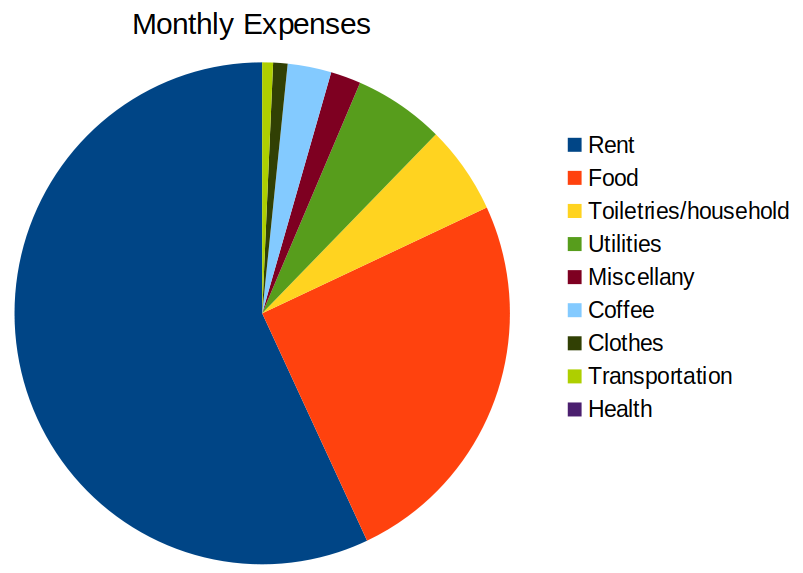
a look at my typical monthly expenses
Not included in the above pie chart are any business expenses that I can deduct from my taxable income, most healthcare expenses (which I could pay for from my pre-tax Health Savings Account), my self-employment tax assessment (half of which I can deduct), or money I put aside for retirement (which I typically do in tax-deferred accounts).
I now rent an apartment at which many of the utilities are bundled into the rent. This makes it difficult to compare expenses over time, as in some past years utilities were a more significant distinct line-item.
My transportation budget is very low because where I live it’s easy to get around on bike and so I don’t own a motor vehicle and rarely need to use one. I’ve also been learning to do my own bike repairs and maintenance at the local “bike kitchen,” which keeps my costs even lower.
My health expenses were low last year, so I didn’t have to dip into my Health Savings Account. It’s replenished enough to more than cover my deductible in case I run into bad health luck. I use it more as an additional retirement savings vehicle than for health expenses these days.
My yearly living expenses take up pretty much all of my “under the tax line” budget, but I’ve got enough squirreled away in savings now that I don’t feel like I’m cutting things too close for comfort.
However, if I were to budget-in the imposed self-employment tax (which I don’t intend to voluntarily pay, but which could be seized from me), that would come to another $4,500 or so of expenses, half of which also counts against my under-the-tax-line budget. And even if the government never gets its hands on that money, I’ve adopted the practice of making charitable donations to match the amount of my back taxes that become uncollectible due to the statute of limitations. For example, if my oldest tax debt is voided by the statute of limitations , I hope to write a check for $5,007 to some charity to celebrate. I can’t do that within my budget: I have to dip into savings, and I may ultimately have to tap my retirement accounts if I want to keep that up year after year. But I don’t expect this will be any great sacrifice or that it will cause any insurmountable personal hardship; I think I have a sufficient buffer for this.
My 1040: A walk-through
Here’s how I expect my 1040 will work out . First, my Total Income:
| Total Income | $44,914 |
|---|---|
| Business income | $31,859 |
| Capital gains | $8,881 |
| Roth conversion | $4,174 |
My business income is from my consulting work as a technical writer and from sales of my books. That income was lower than anticipated this year (my billable hours can vary wildly from month to month, which makes annual income targets hard to hit). This left me a lot of extra room in my zero-tax-bracket, so I took advantage of this by selling a small cache of gold and silver coins I’d bought years ago. Apparently you can’t get the 0% low-taxable-income long-term capital gains rate on precious metals like this. The best you can do is your marginal income tax rate. But for me this year that rate is zero, so with that and the recent spikes in gold and silver prices, it was a good time to sell. After selling all I had, I still had $4,000+ room in my 0% bracket, so I converted some of my traditional IRA to my Roth IRA so I could keep that money income-tax-free from here out.
Now on to my Adjusted Gross Income:
| Adjusted Gross Income | $23,464 |
|---|---|
| Total Income | $44,914 |
| HSA deduction | −$5,300 |
| ½ self-employment tax | −$2,251 |
| SEP deduction | −$5,900 |
| IRA deduction | −$8,000 |
, I put away $13,900 for retirement and another $5,300 for either current medical spending or for retirement. Together, those savings represent more than 42% of my income.
The self-employment tax deduction works like this: When you work for someone else, that employer pays half of your FICA and the other half comes out of your paycheck. This means the half paid by your employer doesn’t count as your income and so you don’t pay income tax on it. If you’re self-employed, you are supposed to pay both halves of the tax, so the IRS lets you take half (roughly) of your self-employment tax as an income tax deduction to even things out (even if you’re refusing to pay, like I am♦).
My Adjusted Gross Income is below the $23,750 threshold at which I get the maximum rate on the Retirement Savings Contributions Credit. That is the target I try to hit in order to get my federal income tax down to zero.
Now we go from Adjusted Gross Income to Taxable Income:
| Taxable Income | $7,714 |
|---|---|
| Adjusted Gross Income | $23,464 |
| Standard deduction | −$15,570 |
| Qualified Business Income deduction | −$0 |
The Qualified Business Income deduction is 20% of that portion of my income that comes from self-employment, capped at 20% of what my taxable income would be without the deduction, but minus my capital gains. The first Trump administration cut corporate income taxes, and this deduction was designed to give a similar break to non-corporate business entities (like me) who declare business earnings on our personal income tax forms. In most years since this deduction was enacted I have qualified for it, but this year my capital gains disqualified me. It has never actually made a difference to the bottom line of how much I owe, though.
Anyway, from there, my tax owed:
| Tax owed | $4,501 |
|---|---|
| Income Tax | $771 |
| Retirement Savings Contributions Credit | −$771 |
| Self-employment tax | $4,501 |
I plan to file a tax return that shows these accurate amounts, but I will not include a check for the tax due.
Other Goals
I hope other people will resist their taxes too, and I have tried to make The Picket Line a good resource for people who are resisting or considering it. But I’ve been much less active on this front lately. A while back I stepped back from the blog and stopped creating new content for it. I’d gotten tired of being a tax resistance scholar and activist, and felt like decentering tax resistance in my life, to make it more incidental, and to occupy myself more with other pastimes.
I did however create a free, on-line version of Tax Strike Tactics — an updated version of my book 99 Tactics of Successful Tax Resistance Campaigns. And I spoke on a NWTRCC panel about “Resisting Taxes in the Trump Era.”♦ It continues to baffle me how few ostensible political activists, principled “opposition” partisans, allegedly god-fearing Christians, and so forth, are willing to consider stopping their support of trumpery and its bipartisan and bureaucratic enablers. (There are some!) In general, the American people seem doomed to support the government no matter how reductio ad absurdum that gets. But now I’ve just baked that in to my worldview and am trying to Stoically observe it and let it go without getting worked up about it.
Much of my “activism” of late is less focused on politics and protest and rebellion, particularly on the national/global scale, and much more focused on embarrassingly wholesome direct action at the local scale. I’ve been volunteering regularly for the local food bank at one of our farmers’ markets, bringing thousands of pounds of fresh donated produce to a food pantry to give to hungry families. And I’ve been working as operations manager for a mobile shower trailer program that serves homeless people in our community several times a week. As a side project there, last year I created VivaSLO!, a free on-line guide to avoiding, surviving, and escaping homelessness in San Luis Obispo county. (All of this volunteer work is easier for me because of the reduced and more-flexible work hours that are part of my tax resistance, and so can be seen as another form of tax redirection.♦)
I’ve also been continuing my work on a sequence of essays examining the virtues and how to improve in their practice. It has been an unexpected delight this year to discover that virtue-oriented guidance has become one of the best tools yet discovered for guiding the development of the AI characters who are becoming so important in our lives. This makes my virtue-scholarship, which at times could feel like nostalgic throwbacks to unfashionable ways of thinking about ethics, feel prescient and very now after all.
Prospects for the coming year
We are in an era of (among other things) considerable uncertainty regarding the future (or even the present) of the tax code. But assuming tax law (or its equivalent in trumpery) remains more or less the same, and assuming no major unexpected expenses or windfalls, I’m well-positioned to live comfortably and well under the income tax line again , though I will again likely “owe” (and refuse to pay) self-employment tax.
I’ve prepared for the possibility that the IRS may try to seize money from me for unpaid back taxes, so in case this happens, it won’t be a disaster. And, if they fail again, I’m also prepared to dip into my savings to give to charity in celebration.
So on to of my “experiment.”