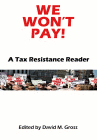
A plug: Plenty of people have opinions about whether or not nonviolent
activism is an appropriate alternative to violent opposition or acquiescence
to injustice, and if so under what circumstances this is the case. But if you
want to learn about how nonviolent activism works, what its strengths and
weaknesses are, and what we can learn of its effectiveness from an
unsentimental look at the historical record, Gene Sharp’s three-book series
The Politics of Nonviolent Action (Amazon:
part one: “Power and Struggle”,
part two: “The Methods of Nonviolent Action” and
part three: “The Dynamics of Nonviolent Action”)
is what you’re after. (Another useful Gene Sharp pamphlet,
From Dictatorship to Democracy: A conceptual framework for liberation
is widely-available on-line.)
Sharp is the founder of The Albert
Einstein Institution which conducts research and analysis into nonviolent
activism, and also exchanges information with activists and governments
worldwide — training activists on how to use nonviolent methods for political
ends, and showing governments how to use the power of popular nonviolent
resistance to supplement or replace conventional military homeland defense.
One Richard Parker did
some interesting back-of-the-envelope calculations
. He took the $87 billion that Dubya
announced he’d be asking us to pay to clean up after the adventure in Iraq,
added to that the $55 billion extra that members of his administration suggest
he forgot to mention. “On a whim,” Parker writes, “I investigated whether $142
billion (87 + 55) is sufficient funds to buy enough gold to pave the highways
with gold.”
He notes that at today’s prices gold costs about $12 per gram, and that there
are about 330,000 “lane kilometers” of interstate highways, with each of these
lanes being in the neighborhood of 3.6 meters wide. “According to
FTC
labeling requirements,” Parker notes,
“24kt gold plating must be at
least 0.5 microns thick to be called ‘gold plate.’” By his calculations, the
complete U.S.
interstate highway system could be gold-plated with $142 billion in gold at
today’s price, with 10,000 “lane kilometers” worth of gold left over to pave a
few extra roads in important congressional districts.
This begs the question, of course, of whether this would be as much of a
delight and consolation to our nation’s drivers as the slump in gas prices
that is anticipated when Iraqi oil starts hitting the market in quantity.
For more information on the topic or topics below (organized as “topic →
subtopic →
sub-subtopic”), click on any of the ♦ symbols to see other pages on this site that cover the topic. Or browse the site’s topic index at the “Outline” page.