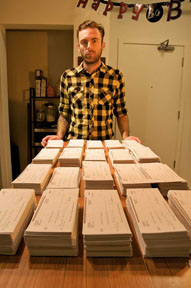
Evan Reeves with his 5,574 checks
Tax resisters, as well as people just disgruntled or disgusted with their taxes, will frequently stumble on the passive-aggressive tactic of paying their taxes, but in a way that is particularly inconvenient for the tax collector. Some times also, they will choose a mode of payment that is both unusual and that has some symbolic or propaganda value. Today I’ll mention some examples of these techniques.
- Evan Reeves wrote out 5,574 separate checks for $0.96 each to pay his federal income taxes. On each check, in the “memo” field, he wrote the name of a U.S. soldier who died in the Afghanistan or Iraq wars. He enlisted like-minded friends to help him fill in the checks.
- A fellow who thought he did not deserve his $137 traffic fine paid it by folding 137 dollar bills into origami pigs and arranging them in a pair of Dunkin’ Donut boxes to turn them in at the police department.
- Many people have hit on the idea of paying their taxes using the lowest
denomination legal currency available. Here are some examples from recent
years:
- Richard Ross paid his $4,079 property tax bill by lugging eleven sacks of loose change to the county treasurer.
- Normand Czepial paid his Quebec property taxes with 213,625 pennies submitted in an inflatable children’s swimming pool (alas, Canadian law allows anyone to refuse to accept more than twenty-five pennies in a single transaction).
- Tax resisters in Bilbao paid part of their fine with 20,000 pennies.
- Ron Spears paid a past-due property tax bill with 33,000 pennies, carried into the county treasurer’s office “in buckets on a hand truck.”
- Australian war tax resister Robert Burrowes has tried to pay his taxes in
a number of odd ways:
- with a truckload of “Aboriginal land”
- with medical supplies
- with 104 trees
- with 94 shovels
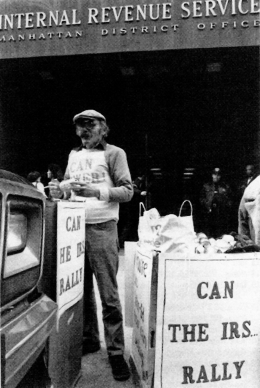
Homeless artist John Ed Croft tried to use aluminum cans, “the currency of the homeless,” to pay his income tax in .
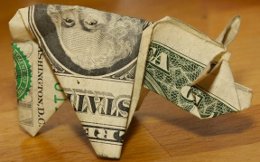
One of 137 dollar bills folded into origami pigs that a man used to pay his traffic fine.
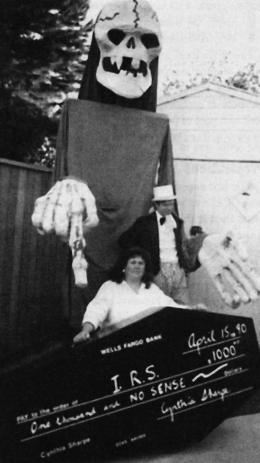
War tax resister Cynthia Sharpe prepares to pay her taxes with a check written on a giant mock-up of a coffin lid.